New Bridge for Kittanning (1931)

November 27, 2012 in Business District, History, News, Nostalgia by Pete Harmon

The Old and New Bridge Side by Side

Besides the Courthouse, one of the main focal points for Kittanning is the bridge.  At one time to easily reach Kittanning from the west, the Kittanning Bridge was needed to reach the destination of town. Very few options existed upstream or down the river. There were a few ferrys at various spots, but the loading and unloading made for a long day. Having the bridge really increased the commerce trade for the farmers, to bring their crops to the markets of Kittanning.

The construction period for the new (current) bridge was around 1930-31. A bridge was already on site, but in 1928 the War Department declared the bridge to be removed, due to obstruction to navigate. They ordered the construction of a new span and if not, then Armstrong County was subject to penalties for non-compliance. A 400 foot wide channel with 9 foot depth, and 47 foot minimum height clearance was required. The existing bridge was so low that barges had difficulty supplying material for #7 Lock and Dam that was already under construction.

There was strong advocacy from as far north as Franklin and Oil City to develop navigation with the projected building of Locks #9 and #10 also. Without the raising of the bridge, the future pools developed to navigate the waters would be wasted. It was believed that the natural resources of sand and gravel, coal, coke, and petroleum products, would provide a sufficiently large amount of tonnage to justify the expenditure.

In 1929 Pennsylvania Governor John S. Fisher signed a bill, that permitted the Commonwealth to take over the bridge as part of the State’s primary roads. This secured the funding, but in turn the Highway’s Engineers were in charge of selecting the site and design of the type of bridge to be built. Even as similar as today’s political situations, the county was freed from financial obligations, but lost jurisdiction on the location. There was strong opinion that the location be moved one street south of Market to Jacob Street as the crossing. This would have eliminated the sharp curve at the bottom of Pine Hill Road which was nearly 180 degrees and also provide less than a 90 turn, creating  a safer entry onto the bridge at the bottom of the steep hill. The northern end of Applewold would be eliminated. Meetings were held at the Chamber of Commence, and petitions were signed by Kittanning businessmen and citizens to secure the Market Street location. The town won this hard fought battle.

At that time only Pine Hill Road was available to travel to the West Kittanning area, south to Pittsburgh, and west to Worthington. The existing road frequently traveled today to the Kittanning Highlands wasn’t  built at this time.

The pilings are nearly completed for transfer of the bridge. (Arm County History Society – Gordon Baum Photos)

To accommodate the traveling public, wooden pilings were built upstream to moved the old bridge for temporary usage while the new bridge was being constructed. With the advent of the automobile and truck traffic, the newly built structure would provide service for many years. Within a few years after the construction of the bridge, a new road was built to carry traffic to the Kittanning Highlands and to minimize usage of Pine Hill Road, which still had the dangerous curve at the bottom.

Circa 1926 Mary (Bonner) Miller on the Old Bridge (Mary Bonner Miller Collection)

Here is a Photo from my Good Friend Mary (Bonner) Miller when she was about 3 years old (Circa 1925)  and taken on the old bridge. Mary is one of the few people still living that recalls being on the Old Bridge. She says that you could see the water between the wooden planks, and how that was quite frightful as a child. She even recalls as a child her father Alex Bonner taking her to see the new road being built to West Kittanning, as the family lived at 204 Arthur Street at the time.

“The New Road” to West Kittanning (From 1933 Kittanning Yearbook)

Construction Phase of the Current Bridge on the Applewold Side. (From Calvin Miller Sr. Photos)

Materiel storage for construction of the bridge at the Shawmut Railroad station.

Older Photo(on right) from Calvin Miller Sr. He resided at 134 Allegheny Ave. in Applewold and would visit the construction site frequently.


Downtown Kittanning Eatery

October 9, 2012 in Business District, Fire & Fire Companies, Genealogy, History, News, Nostalgia by Pete Harmon

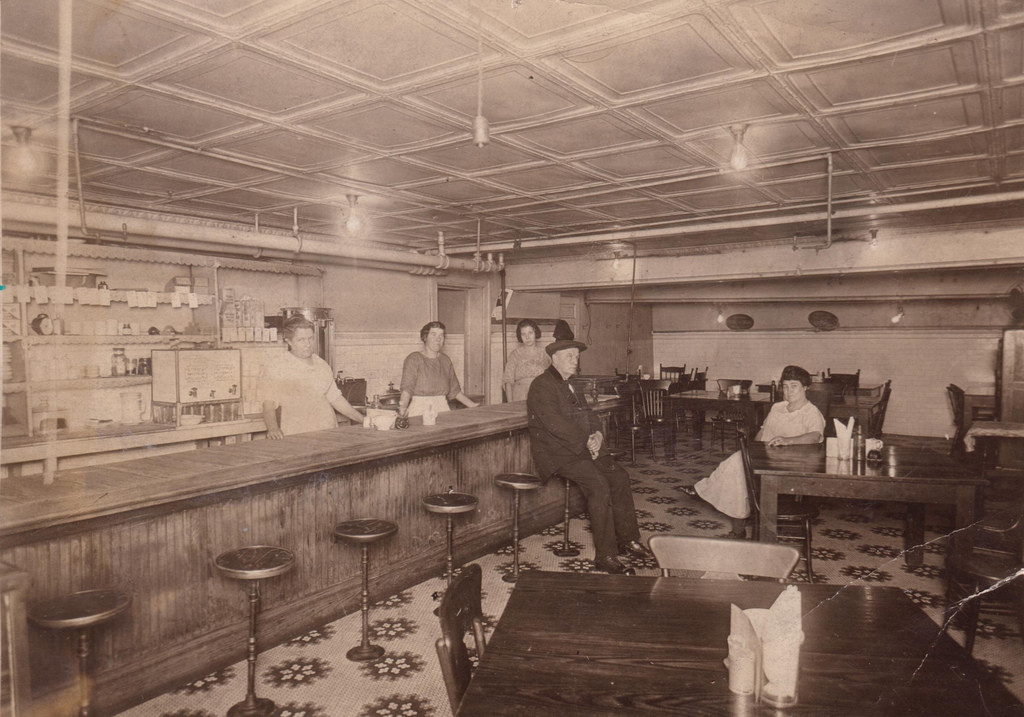
With the population nearing its peak in Kittanning and before corporate restaurants took over, plenty of Kittanning families provided home-cooked meals to the busy downtown area. One such place was G. F. Walker’s Restaurant. This would be one of the first business that you would’ve seen as you came across the Kittanning Bridge. It was located at the current location of Allegheny Real Estate on the corner of Market and South Water St.

Originally form Sykesville, PA. George F. Walker first occupation was providing home cooked meals in Kittanning.  Prior to the Restaurant business he was listed as a motorman for the trolley, then living in Wickboro. A 1904 directory lists 932 rear Orr Ave. as his residence. I’ve located a newspaper article stating that he resigned form the trolley company in 1910. Then in a 1911 advertisement in a School Directory, an ad was placed for his Restaurant business located below. (George F. Walker is wearing an apron with the suspenders in the photo)

George F. Walker’s Restaurant Located at Market and S. Water Street (Photo from Diane Wolfgang Ross)

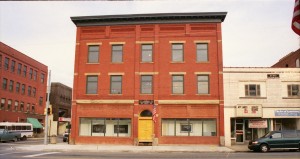
The angled door entrance would have been right on the corner of the sidewalks at Markets and S. Water Street as shown below where the Allegheny Real Estate sign is located.

Same Location as Restaurant (Photo by Pete Harmon)


1911 Adverstisment


Having several occupations during his lifetime, George F. Walker was born in Skyesville, PA in 1871. From around 1900 till 1910 he worked for the Kittanning and Leechburg Railway Company in Kittanning which was established around 1890. The trolley would have run in front of his Orr Ave. residence.

George F. Walker’s brother-in-law prior to 1900 established a Cafe.  Alvin George was the owner of George’s Cafe, at that time located at Market and South Mckean Street about 2 blocks away the current location of Dizzy Lizzies. Did Alvin George have an influence, or did his Alvin’s wife Mary? Mary (Walker) George was the sister of George F. Walker and was also running George’s Bakery besides her husband Alvin running the Cafe. This was in the same block as G. F. Walker’s Restaurant on Market Street. You would have to be sure that the George’s expertise would have been of a great assistance in starting a new venture.

No doubt the Restaurant would have been short lived, as the fire of 1915 at  the Eagle House Hotel placed the building out of commission.  A mystery remained if the G. F. Walker Restaurant actually was located at this place due to the fact that early photos don’t show the angled corner of the Eagle House building, only a square enclosed corner.  But, a large panoramic photo commonly on display shows that it was likely. A small portion of the photo zoomed in shows a glass structure on this corner. The photo also appears to show a possible damaged roof, but no conclusion of how much it burnt at that time is known. There are newspaper articles that stated the structure remained intact for a few years, to what degree is unknown.

Eagle House West Kittanning View

At some point George F. Walker then moved to Applewold and continued to live the remainder of his life, becoming Superintendent 0f Water and Streets in Applewold Borough.

Trolley man George F. Walker at 932 Orr Ave rear which still stands today. (Photo from Harry Bonner)

During the early late 1800′s till 1915 the Eagle House Hotel was located here. It had the advantage of sitting next to the river, which would have been ideal as riverboat traffic arrived frequently. This was a very large structure that took up nearly the entire half-block of the block of 100 Market St from Water Street to Water Alley.  As stated, the building was taken by fire and never was to be in operation again. Most of the structure remained for several years, but plans to rebuild and/or to revise it never came to fruition. Here are some photos of the Eagle House Hotel in it’s heyday and after removal of the structure.

Looking East from the Bridge in the 1800′s. (Photo from Rita Gill-Crawford)

1921 Debris of the Eagles House, 100 Blk of Market St. South Side. (Photo from Linda Mockenhaupt)